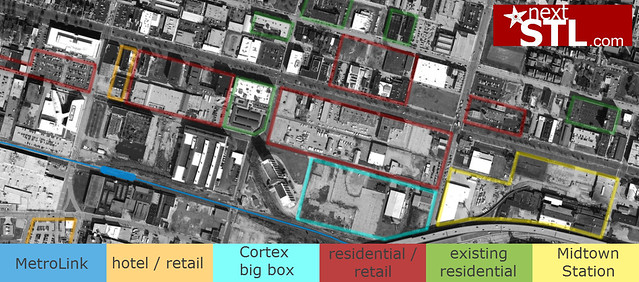


With news of Pace Properties' Midtown Station, the vortex of Cortex and word that some Swedish retail thing is set to put a stake in the ground, Midtown St. Louis is quickly changing from a confusing mix of abandoned industrial sites, parking lots and vacant land into a confusing mix of retail, residential and office proposals. There's nothing definitively right or wrong about any of the proposals, but taking a more broad view of the moving pieces should better inform the conversation. Often, a visual representation is needed. Hopefully the two graphics here provide added context for discussion.

In aggregate, just more than 300 residential units are planned for the area currently. Another 1,410 residential units have been indentified as possible future development. Nearly 850,000 GSF of potential retail development has been identified and more than 3,000,000 GSF of office and research space is envisioned.

{potential future development of Cortex – source}
nextSTL story on Midtown Station Development
nextSTL story on IKEA at Cortex

I think this Midtown development is really exciting 🙂
Let’s take the Team Four, Rand and benign neglect conversation here: http://staging-nextstlcom.kinsta.cloud/urban-living/team-four-citywide-implementation-strategies-the-draft-comprehensive-plan-1976
The two midtown development–cortex and midtown station–are a striking
example of the prognosis for st louis in the Rand study in the 1970s.
George Wendell aind I, both of St Louis U, were major consultants to that
study. Basically, it projected continued population decline in the city, par-
ticularly in older low income areas and recommended a policy of benign
neglect. Rather than start massive urban renewal policies and displace
tens of thousands, let nature take its course, and let the area gradually
depopulate on its own. At some point, it would become so depopulated that
redevelopment would be feasible. This approach was adopted in a subse-
quent Team four study, and became the de facto policy of the city for
several decades.
In the 1990s, some projects became possible. In the north side near
14th and Cass, new market rate housing was developed, and somewhat
west of Jefferson, Jeff vanderlou contined its efforts of rehabilitation. Large
public housing projects were abandonded and in some cases low rise was
substituted. Along Franklin east of Jeffferson some new commerical de-
velopment occured. All of this received little publicity
In the central corridor, substantial new housing by McCormick Baron
and the expansion of St Louis U started the redevelopment of the area
from Compton to Sarah and beyond. With the expasion of AG Edwards
and Harris College, the central corridor was being filled in.
With the central corridor on the verge of completion, some natural
forces are occuring to expand redevelopment north and south. The Grove,
Shaw and dogtown areas are joining the HiIll on the south side and some
new and rehabilited work is occuring north of Delmar and west of Union
The city will never hits its old population of 850,000. But, to paraphrse
the great man, we have seen the end of the beginning and things should
start getting even better
St. Louis PAID for ‘advice’ like that?! What is “complete” about the central corridor? Where do you get your ideas from? Amazing…..
Too true. “…let nature take its course, and let the area gradually
depopulate on its own.”
Damn, that is cold-blooded and heartless. I suppose no one thought to take into account the presence of human beings, and what affects this policy may have had on societal and neighborhood stability and public health.
what was the alternative? Nixon policies had reduced
urban aid. Investors were nowhere to be found. Middle
income blacks were beginning their move to the sub-
urbs. There was no support for large scale urban re-
newal among the blacks in north st louis, and piece
meal development had little support from investors or
the federal government. The residents of the depopulating areas were improving their indivudual
lives by moving out of old houses into newer houses
(only those who grew up in newer houses trend to ro
manticize old buildings; those who grew up in cramped
3 or 4 room apartments are glad to move out, yes,
even to a “tacky” vinyl clad ranch house in North County-
This is an interesting and important discussion. I’ve posted the Team Four plan for reference and to provide a better place for discussion. Let’s move on to here for Team Four: http://staging-nextstlcom.kinsta.cloud/urban-living/team-four-citywide-implementation-strategies-the-draft-comprehensive-plan-1976
Team Four *memorandum*
I’ve no doubt that overcrowding in flats and tenements and the promise of modern amenities like air conditioning drove people to the suburbs. However, I don’t buy the argument that people got tired of “old houses”, at least not in the sense that they tired of the external architectural forms themselves (not saying that’s an argument you’re making, but others have). I don’t think anybody is romanticizing raising a family in a 600 sq. ft. flat without air conditioning in the blistering St. Louis summer heat. It’s the external form–and a perceived sense of community resulting from density–that gets romanticized i think (and rightly so in my humble opinion).
good point. But consider this: the reason that there
was such density in the old neighborhoods is that there
were a lot of people living in small apartments. My
study of census trends shows that the biggest decline
in occupied units in older neighborhoods was in multi=
family buildings over four units. I guess you could
have both, but probably not for working class families,
who were the brunt of St Louisans in the time of high
population
oh, of course. i agree. and i don’t think we need to return to that level of density to achieve the same level of community. old multi-families can be refitted for fewer occupants (as is happening). and new construction can build up, allowing more space per unit. there will always be a demand for small units for singles, students, etc. but families need more spacious city options.
I apologize for inferring that you and Mr. Wendell were personally ‘cold-blooded and heartless’. As you say, you were tasked to come up with alternatives minus money. And you did. And it meta’d into the wretchedly immoral Team Four plan. It’s merely an outgrowth of our country’s institutionalized insouciance. The Federal government could find billions upon billions to purchase 5000 F4 Phantoms from Mr. McDonnell (along with billions more for getting punk’d by the French into taking over their dirty war), but not a penny for our own citizens.
And now we see ‘depletion’ as National policy, as engendered by the Detroit special administrator’s bankruptcy filing. With the promise of fire sale prices for artwork from the Detroit Institute of Art, and the sale of the jewel of the Detroit public parks system, Belle Isle. How convenient for the wealthy and developers.
Burn in hell, Governor Snyder.
From fifty years of observing and studying St Louis and
other cities., as well as participating in development programs, being active in politics, talking to many people
and most of all, not going along with the conventional wisdom
of half-educated ideologes \\
Indeed. Don’t let a few half-informed gas bags scare you away from this site Dempster. You provide the long-term view that is lacking in discussions here.
I studied under George Wendell at SLU in the 1980s as an undergrad.
It easy to forget in 2013 where the city was in 1973.
“Benign neglect” is never a good idea. There is ALWAYS value and financial interest in any area. The challenge is to realize it.
The Rand study in question is here:
http://www.rand.org/content/dam/rand/pubs/reports/2006/R1353.pdf
Thank you for publishing these two reports. I note that
taken together, the reports both indicate that “benign
neglect” refers only to the physical status of areas that are
too far gone to redevelop without massive clearence
It does not refer to neglecting the needs of the people living
in those areas In many instances, those people living in
the areas had begun moving out. partly because of the Civil
Rights movement and the social programs of the 1960s, and
a result was a decline in demand for housing in these areas.
The two reports essentially recommended land-banking and
discouragement of scattered physical development until
such time as sufficient vacent land became available for
large scale development. In other words, the thought
was an acknowledgement that the much-criticized policy of
massive urban renewal of the 1950s and early 1960s had
too great of a human toll. As the Team Four study noted.
the city still had an obligation to provide services for those
who are left.
The result of these policies can best be sen by the fact
that the McKee plan for much of north st louis east of
Grand is now possible. It relies on the fact that substan-
tial rdevelopment can occur without massive forced re-
location. That is exactly what was envisioned in the
Rand study and the Team Four study
A $16,000 demolition permit for the BP station was filed last week, 07/26/2013: “WRECK GAS STATION/CAR WASH (NO TANKS OR CANOPY)”. A simultaneous $7,750 demolition permit to “WRECK COMMERCIAL BUILDING” was requested for the Hollywood Motor Co. next door.
Is there some historic preservation reason all these plans include keeping the grain silos. I’m not in a huge hurry to knock them down as there are many lots available on which to build but i really don’t understand planning to keep them as a centerpiece of the neighborhood. I’m not sure what kind of realistic adaptive reuse can be done with them either.
I don’t think preservation is much of an issue. The expense would be pretty substantial to knock down the silo and clean up the site.
I used to hate it, but now I kind of like it, a relic of our industrious past. I think if they removed the unused railroad tracks from the property and landscaped it, it could be used as a giant billboard. Similar to the Cotton Belt building in the industrial North Riverfront area. Artwork welcoming people to the City, maybe an advertisement for Midtown Station or a Swedish type retail store ;). Maybe even apartments. It’s not out of the ordinary to see these buildings repurposed, it’s been done elsewhere.
It’s not a relic to the dozens of companies that rely on the grain transferred there.
Yes, I’m aware of this now. I never really noticed any activity on the site but after reading many of the other comments I now know that it is very much in use. My mistake.
Isn’t the grain silo still functioning to some extent? Maybe not, but I thought I read somewhere that it still is active…
My understanding is that it’s still in use. In fact, if you look closely, the silos themselves were just patched. They’re well-maintained.
Driving between home and work I have seen trucks at the silos so I would def imagine that they are still used.
Yeah, if you walk around the site it is whirring and lights are on.
I thought i remember reading that cortex had money and a plan to light the silo?
I haven’t heard that Cortex planned to do anything. But there was a pitch on here to do just that.
The grain silos are in full use and owned by the Ray-Carroll Cooperative. As best I could tell, they’re well maintained. The co-op owns about 10 silos.
Web page: http://nx6.r3.sl.pt
It probably wouldn’t be that hard to buy the site from the coop, but I would imagine demolition cost and clean up would be significant.
They might be reluctant to allow someone to paint a sign on the silo because covering later it would be very expensive. It doesn’t look like the concrete has ever been painted, and once you paint concrete you have to continue to maintain/paint forever.
You can get a good look at the silos by driving by the Duncan Ave entrance.
I’m sure they’d allow a Pink Floyd Laser Light Show – wooooooooo!
Actually, whenever I went on the Sergeant Floyd at the Riverfront as a kid in the late 70’s early 80’s and saw the creepy uniformed mustachioed dummy dressed in what I guess was ancient Corps of Engineer livery – I entertainment myself with internal thoughts of a Sergeant Pepper/Dark Side of the Moon mashup.
Maybe I should try to organize the inaugural (get it) Pink Floyd/Beatles laser light show on the Great St. Louis Grain Elevator and dedicate it to Sergeant Floyd.
That’s cool. I was not aware they were in use anymore. Good to hear. Hopefully we can get something done on the facade!
Plus: why would CORTEX want to move jobs & business activity OUT OF its area?
It’s amazing how quickly this entire area is going to change. I’m hoping the momentum keeps snowballing downhill and more projects get lined up to start filling in the areas around it. We could see an entirely new central corridor in just 5-10 years!
Need those 1,410 future residential units now. I just did a search for apartments in the area, not a great selection unless you have $1,000 — 1,500 plus to drop on rent each month… I guess high rent means better developments, but… I’m not compelled to move there yet, at least not from what I have found searching online.